- by foxnews
- 18 Sep 2026
T rex footprints unearthed in first-ever discovery 66 million years after creature walked the Earth
The first known T. rex track of footprints stretches over 23 feet in North Dakota's Hell Creek Formation, with four massive prints revealing how the predator walked on Earth.
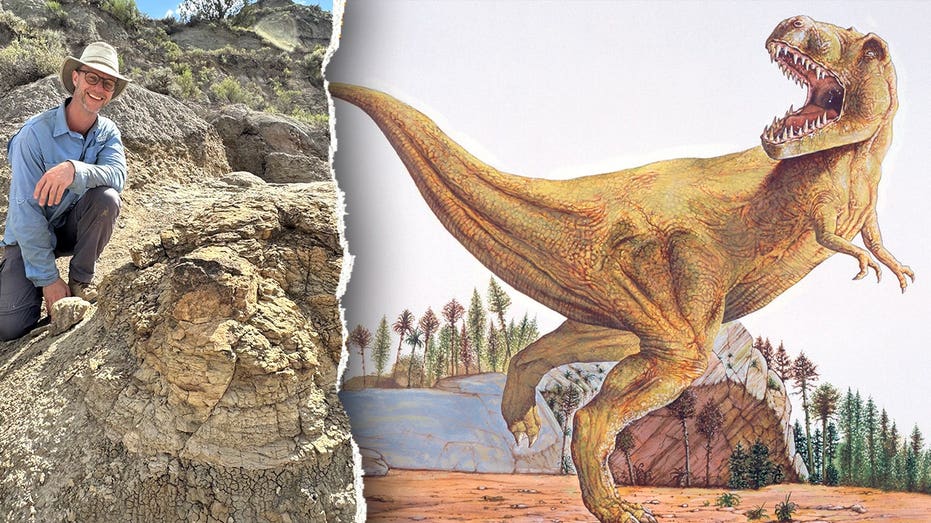
The findings, which centered on footprints discovered near Marmarth, North Dakota, were published Sept. 9 in the Journal of Vertebrate Paleontology.
The trackway, or sequence of footprints, was discovered in 2025 in the Hell Creek Formation of southwestern North Dakota, on federal land administered by the U.S. Forest Service.
Pictures from the site show researchers examining the massive, three-toed prints in the rocky terrain.
The prints are roughly 3 feet long - and their enormous size led researchers to determine that they were left by an adult T. rex.
While other isolated footprints have been attributed to adult T. rex, researchers said no adult T. rex trackway had been described previously.
"This is the first time scientists have described a sequence of tracks, or trackway, likely left by this most famous of dinosaurs," the release also noted.
Tyler Lyson, the senior curator of vertebrate paleontology at the Denver Museum of Nature & Science and the study's co-author, told Fox News Digital he was initially skeptical when volunteer Kent Hups, a high school teacher, spotted the print.
"Initially I wasn't convinced because it was only one print," Lyson said.
Rocks, he noted, "can erode into many different types of shapes."
"I thought, well, if there's three, that's a pattern," he said. "If we can find a third print, then I'll be a true believer."
The team began digging farther into the hill - and within about 30 minutes, they struck a third print.
"At that point, myself, [plus] Kent, who found the trackway - we were absolutely ecstatic," Lyson said.
The four footprints - two left and two right - were spaced at a stride of approximately 13 feet.
The dinosaur may have been walking between 3.5 and 4.5 miles per hour - much like humans do today - the researchers estimated.
The study's lead author, Peter Falkingham, a paleobiology professor at Liverpool John Moores University in England, then analyzed the footprints remotely using the 3D data, even though he never saw the tracks in person.
The team returned to the site this summer and made another discovery while excavating farther into the hill: a fifth track.
"I have no doubt that if we were to continue to dig further into a hill that we would find more," Lyson said.
The footprints are each more than 3 feet long. They likely weigh between 800 and 1,000 pounds, according to Lyson.
At the museum, researchers plan to clean the tracks - and Lyson said he's hopeful they could contain preserved skin impressions.
"By cleaning these tracks, we might be able to have a better idea of what the actual foot of a T. rex looked like," he said.
The recent research follows other dinosaur-related discoveries from across the world.
you may also like


- by foxnews
- 18 Sep 2026
US warns Americans to stay vigilant as terror risk looms at major vacation hot spot

- by foxnews
- 18 Sep 2026
Dolly Parton could soon have major airport named in her honor after unanimous vote



travel
- by foxnews
- descember 09, 2016
Lost city where Jesus performed miracles has finally been identified, expert says
Bethsaida, the home of Apostle Peter and the setting of Jesus Christ's miracles, may finally be identified after a decade of archaeology work at El-Araj.
read more