- by foxnews
- 05 Aug 2026
Battlefield robots open new front in innovation war with major US adversary
EdgeRunner AI's onboard neural network lets military robots continue missions after losing connectivity, eliminating reliance on Starlink or cloud.
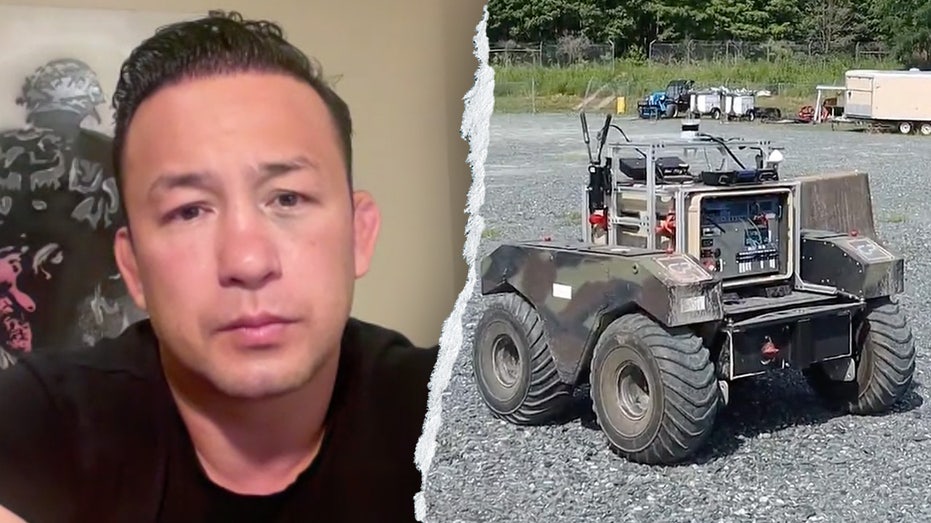
Working with the Army Research Laboratory, defense AI company EdgeRunner AI has developed an onboard AI system that allows military robots to function in the battlefield without relying on cloud computing or an internet connection in environments where connectivity is lost.
"We like to think of robots as the next frontier of AI," EdgeRunner AI founder and CEO Tyler Saltsman told Fox News Digital.
"Think of them as a very far-out edge device, kind of like a cell phone, a tablet or a laptop. But now what we can do is we can put a brain, or a neural network, right on that robot so that robots can have context when they're on a mission helping the warfighter."
Saltsman said it's important for the U.S. to stay ahead in the global AI race, calling China's dominance in drone manufacturing "problematic."
"Whether or not China's ahead of us is debatable, but if China is, it's not by much," he said.
Saltsman said today's AI is "too generalized," which is why his company is developing technology built for specific military missions.
"Warfighters don't need 19th-century poetry," he said. "They need specific intelligence to his or her occupation in order to make better decisions in the heat of battle and that can increase the probability of winning the fight."
When communications are cut off, Saltsman said the military will need autonomous systems that can continue making decisions on their own.
"You can have a human pilot that controls the ground robot or the drone in the air," he said. "But then if they were to be jammed by a radar jammer and lose connectivity, then the neural network on that robot can still continue the mission and still aid the warfighter."
Saltsman argued the military "can't rely on internet access in war," warning that depending on systems like SpaceX's Starlink could add a "risk" to missions.
"The problem with Starlink is if you use it, you're effectively showing the enemy where you are, so you might as well be wearing a beacon on you saying, 'Hey, here's where I'm located,'" he said.
"As drones have become ubiquitous, now ground robots are like the next thing and then eventually humanoid robots so robots that move and look like humans," he said.
Despite the push to advance military AI, Saltsman said safety can't take a back seat and that the technology is built using "transparent" datasets to "understand the biases" of the AI.
"That's another thing that differentiates us," he said. "One of the problems is how to use AI safely, how to put guardrails around it and how to understand it."
While the technology remains in the "development phase," Saltsman said the breakthrough gives robots the ability to understand what they see, not just detect it.
"You can put computer vision models on robots so they can see, but if they don't understand the context of what they're seeing, they're not useful and that's what we're solving for."
you may also like

- by foxnews
- 05 Aug 2026
Battlefield robots open new front in innovation war with major US adversary

- by foxnews
- 05 Aug 2026
Reporter's Notebook: Inside the Senate showdown over Trump's push to scrap August recess



travel
- by foxnews
- descember 09, 2016
Thousands swarm stunning mountain escape as selfie tourism backlash erupts online
Photos are showing massive shuttle lines at Tre Cime di Lavaredo in Italy as selfie tourism overwhelms one of the Dolomites' most iconic destinations for travelers.
read more